
GLOBAL ALLIANCE OF
SUBNATIONAL DEVELOPMENT BANKS
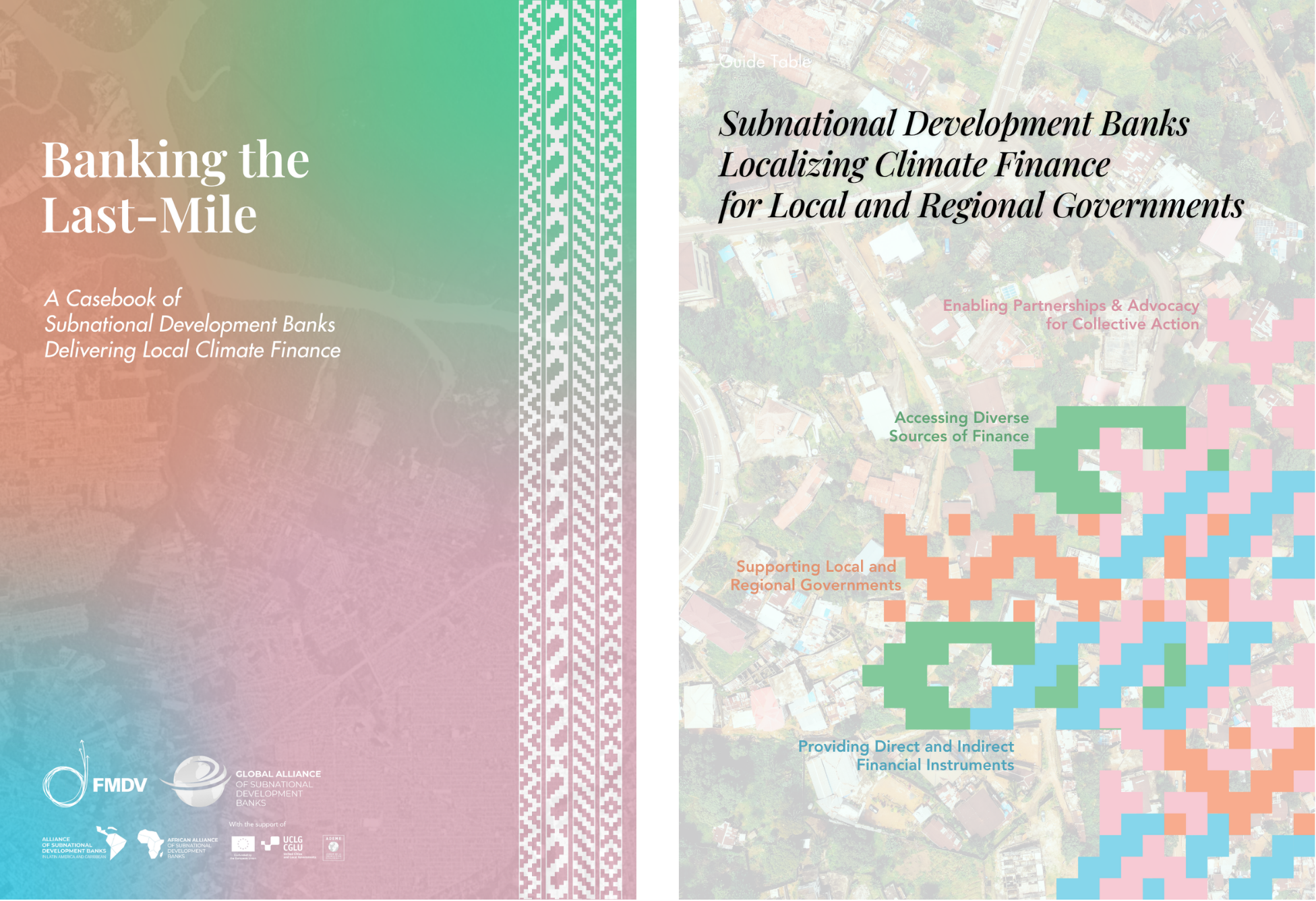
THE CASEBOOK IS NOW AVAILABLE IN 4 LANGUAGES! (EN/FR/PT/SP) Reaching a global audience to share knowledge about how to localize the $1.3 trillion climate finance into cities and regions
THE ALLIANCE'S DEFINITION OF SDBs
- Financial intermediaries defined as Public Development Banks (PDBs) or Public financing institutions
- Supported and/or owned/governed by national, regional or local governments
- Mandated (or with a dedicated division) to provide funding/financing to local & regional governments, support local stakeholders (e.g., SMEs), invest in subnational and/or urban development
- Diverse in terms of status or operating modalities, which can take the form of:
- SDBs, NDBs, Regional and Multilateral Development Banks,
- Municipal / Regional Development Funds,
- Municipal/Regional/Metropolitan Development Agencies,
- Thematic or Sectoral Financing Institutions (e.g. revolving funds),
- National Investment Funds
- and more!
SDBs AS THE LAST MILE PUBLIC BANKS
SDBs execute a public, development-oriented mandate, transferring national funding and/or addressing market failures and inconsistencies.
SDBs are professional financial intermediaries which can lend in local currency, provide guarantees, and channel domestic and international funding and financing to local levels of action.
SDBs are well-established domestic players closely connected to national policies and strategies, and well positioned to implement the SDGs and the Paris Agreement.
SDBs are best-qualified to boost local capacities to structure sustainable local investment portfolios and provide access to international opportunities. (vertical funds, blended finance, credit enhancement, etc.)
A VOLUNTARY, FREE AND NETWORKING SPACE FOR NDBs/SDBs AND STAKEHOLDERS
80+ participating institutions gathered around 2 regional chapters and representing 5 constituencies:
- Subnational Development Banks (SDBs, NDBs)
- International Organizations
- International Finance Institutions
- Local and Regional Governments Networks
- Research & Academic Institutions
Working along 5 objectives:
- Reinforce capacities of SDBs based on peer-to-peer and multistakeholder exchanges and cooperation;
- Enhance the strategic role of SDBs and the contribution of the Alliance to the global Agendas in international fora;
- Align SDBs’ strategies, standards, initiatives, investments and portfolios with the UN-2030 Agenda, SDGs, NUA, FfD, and the Paris Climate Agreement;
- Diversify SDBs’ technical and financial services to local and regional governments and actors;
- Promote portfolios of sustainable, just, and resilient urban investments and boost urban and subnational financial markets
WHY THE GLOBAL ALLIANCE OF SDBs MATTERS
SDBs are increasingly recognized as essential actors in building resilience and implementing just, inclusive and territorial transitions (from the New Urban Agenda to the 2024 G20 Declaration and the 2025 Sevilla Platform for Action).
Present in close to 100 countries, these institutions are often the only long-term funders and financiers with a public mandate to invest in local infrastructure and basic services.
Yet, SDBs remain underutilized in sustainable and climate finance architecture, facing structural barriers to access vertical funds, concessional finance, and guarantees or in strengthening local capacities for quality project preparation and matchmaking with public and private financiers and investors.
The Global Alliance responds to this gap by building institutional capacity, strengthening cooperation between NDBs, SDBs and Multilateral Development Banks (MDBs), and promoting their recognition in international institutional frameworks and negotiations.
TIMELINE OF SDBs INTERNATIONAL RECOGNITION
THANKS TO THE GLOBAL ALLIANCE AND ITS TWO REGIONAL BRANCHES
INSTITUTIONAL LAUNCHES & EXPANSIONS
Launch of the RIAFCO (Network of African Local Government Financing Institutions)

GLOBAL POLICY RECOGNITION
Recognition of the role of SDBs in the New Urban Agenda

INSTITUTIONAL LAUNCHES & EXPANSIONS
Launch of the Global Alliance of SDBs during the 2019 UN Climate Action Summit, with support from the Government of Cameroon

GLOBAL POLICY RECOGNITION
Recognition of the role of SDBs in the MPGCA Climate Action Pathway on Human Settlements
INSTITUTIONAL LAUNCHES & EXPANSIONS
Launch of the Finance in Common Summit – FICS and integration of the Global Alliance of SDBs

INSTITUTIONAL LAUNCHES & EXPANSIONS
Launch of the regional branch in Latin America & the Caribbean, with the support of AFD, BDMG, FiCS and IDDRI
GLOBAL POLICY RECOGNITION
Recognition of the role of SDBs in the MPGCA Climate Action Pathway on Finance
INSTITUTIONAL LAUNCHES & EXPANSIONS
Launch of the African branch during the FiCS 2 in Abidjan, Côte d’Ivoire
GLOBAL POLICY RECOGNITION
Recognition of the role of SDBs and the importance of a whole-of-PDBs system in the UNSG’s SDG Stimulus to deliver Agenda 20230
SYSTEMIC REFORM & ADVOCACY
U20 Final Communiqué calling for a global financial architecture and MDBs reforms that recognize the role of SDBs
SYSTEMIC REFORM & ADVOCACY
Call for collaboration between all PDBs, including NDBs and SDBs, in the G20 Leaders’ Declaration
SYSTEMIC REFORM & ADVOCACY
FICS’ Final Communiqué calling for a one PDB system that includes SDBs
SYSTEMIC REFORM & ADVOCACY
Recognition of the role of SDBs in the Joint Statement of the Global Taskforce of Local & Regional Governments to FfD4
SYSTEMIC REFORM & ADVOCACY
Integration of the Global Alliance into the Sevilla Platform for Action;
Promotion of subnational finance, NDBs, and INFFs in the Compromiso de Sevilla

SYSTEMIC REFORM & ADVOCACY
Integration of the Global Alliance into the COP30 Action Agenda as pioneering iniative
KEY RECOMMENDATIONS FROM THE GLOBAL ALLIANCE:
ENGAGING COUNTRY-LEVEL ACTIONS & TRANSFORMING GLOBAL FRAMEWORKS
INSTITUTIONALIZING SUPPORT FOR NDBs & SDBs
- Position SDBs as “SDG enablers” with a dual mandate: align local and national priorities with global challenges (climate, risk management and resilience, biodiversity, inequalities) and seize the urbanization opportunity to enhance national and global ambition.
- Establish a specific regulatory framework for SDBs, tailored to their development mandate, enabling better risk management and a more flexible approach compared to private sector standards.
- Increase financial capacity through multi-cycle technical assistance programs, concessional funds, guarantee products, blended finance mechanisms.
Promoting multilevel coordination
- Position SDBs as key partners in reforming and strengthening national financial architecture.
- Support country-led development strategies through bottom-up approaches.
- Create Country Platforms for Localizing Finance to seize the urbanization opportunity.
To fully harness the potential of SDBs, we need a coordinated approach involving ministries, local & regional governments, multilateral & regional development banks, and UN agencies.
Reshaping the global financial architecture
- Build a coherent whole-of-PDBs system where SDBs, NDBs, and MDBs collaborate as a system.
- Integrate SDBs into international frameworks and negotiations.
- Develop an accelerated accreditation process for PDBs and enhance SDBs direct access to vertical funds.
Empowering SDBs & NDBs as climate finance intermediaries
- Establish dedicated local-currency and guarantee facilities.
- Support through SDBs the capitalisation of off-balance sheet mechanisms (SPVs, pooled portfolios, blended facilities) so that the majority of LRGs in EMDEs and LDCs, which will not reach conventional creditworthiness in time, can still access finance at scale.
- Ensure SDBs’ access to concessional funds, technical assistance, and a supportive regulatory framework.
REGIONAL CHAPTERS
Latin America & the Caribbean
The Alliance of Subnational Development Banks (SDBs) in Latin America and the Caribbean was launched in April 2021 by the French Development Agency (AFD), Development Bank of Minas Gerais (BDMG), the Global Fund for Cities Development (FMDV) and the Institute for Sustainable Development and International Relations (IDDRI).
The Alliance now gathers 52 members & contributors, including 29 SDBs & NDBs from 9 countries.
Africa
Launched in Abidjan on October 19, 2022 during the third edition of the Finance in Common Summit (FiCS). The Alliance aims at strengthening the role of financial intermediaries and public development banks in financing a sustainable and just urban transition in Africa.
The Alliance now gathers 43 members & contributors, including 27 SDBs & NDBs from 23 countries.
VOICES FROM PARTNERS


KNOWLEDGE PRODUCTION:
SLECTED PUBLICATIONS & WORKSHOPS OF THE ALLIANCE
The Potential Catalytic Role of Subnational Pooled Financing Mechanisms
Publication - Global - Pooled Financing
COP26 Declaration of Subnational Development Banks’ Alliances “The Last Mile Public Banks”
Publication - Global - COP
Studies on financial resource sustainability and diversification for Local Government Financing Institutions in Africa
Publication - Africa - Financial Resources
The role of SDBs in financing an urban and territorial resilient post-covid recovery
Publication - Global - Urban Resilience
Risk Mitigation Mechanisms for Local Investment – The Role of SDBs
Publication - LAC - Risk Mitigation
Bridging Africa’s urban infrastructure gap: Financial intermediaries for facilitating cities’ access to debt finance in Africa
Publication - Africa - Urban Infrastructure
The role of SDBs in Financing Urban Climate Transition in LAC
Publication - LAC - Urban Transition
Shaping the Future of Subnational Finance Accelerating Together for Urban Transition & Resilience - Report of Annual Forum 2023 of the Alliance in LAC
Publication - LAC - Urban Transition
Accessing Climate Finance: Accreditation to Green Funds
Workshop - Africa - Climate Funds
The Role of SDBs in Financing Urban Adaptation and Ecological Transition
Workshop - LAC - Adaptation
Peer-to-peer exchange: Guarantee & de-risking mechanisms
Workshop - LAC - Guarantee & De-Risking
Aligning SDBs with Global Agendas: Ongoing experiences with norms, standards & procedures in LAC
Workshop - LAC - SDGs